
Like excess lymphatic fluid massaged from swollen tissue, The Lymphie Life is back in circulation — and we have lots to catch up on.
First things first: No, I haven’t had my surgery yet. I appreciate everyone who reached out over the past few months to send well-wishes or share their own experiences with lymphedema surgery. Your kind words meant a lot to me, especially during a time of such personal frustration.
But what happened? At the time of my last update, my employer changed our insurance provider less than a month before my scheduled surgery. This meant I had to reapply for preauthorization with the new insurer, postponing my surgery in the process.
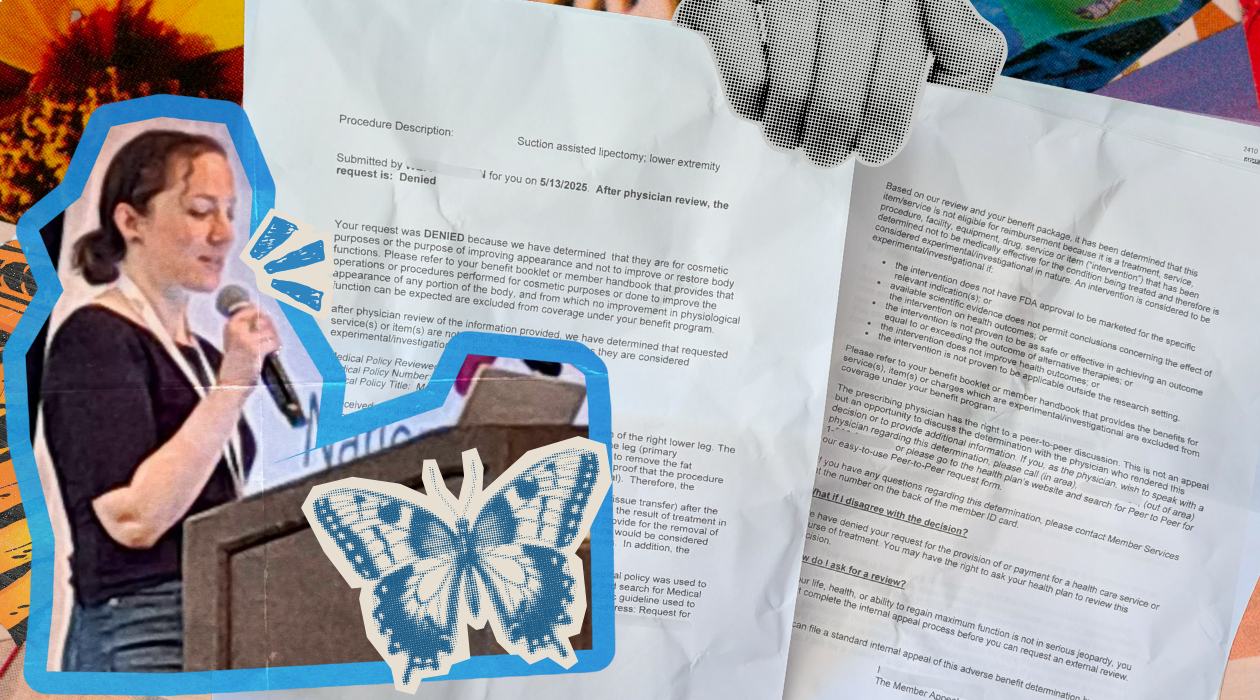
A few weeks after that, I received a letter from the insurance provider. In bold, capital letters, it said: “Your request was DENIED.”

They claimed the surgery was for cosmetic purposes, “not to restore body functions,” and after physician review, they determined the procedures to be “experimental and investigational in nature.”
I couldn’t believe it. They were refusing to cover my surgery on the grounds it was “experimental” and “cosmetic,” and I had a long cry about it on the grounds it was frustrating and unfair. My surgeon’s office filed an appeal on my behalf, but months have gone by without a word from the insurance company, and I feel like I’m back at square one.
Some Notes on Where I’ve Been
The coverage denial really threw me for a bit, and I took the summer off from The Lymphie Life to focus on my own lymphie life.
At first I didn’t mean to go dark — I was burnt out and overwhelmed, and going online only seemed to make it worse — but the more time I spent offline, the lighter I felt. So I embraced the break and leaned into the lull.
Although I disappeared digitally, I kept busy offline. In May, I traveled to Connecticut for the National Lymphedema Network‘s Patient Summit, where I gave a talk to 90 lymphedema patients about advocacy through storytelling, drawing from my own experiences living and writing the Lymphie Life.


For many of the attendees, it was their first time meeting other lymphedema patients, so to watch them realize there was a community for them — let alone treatment, and hope — was really beautiful.
There was a moment during one of the Q&A portions when a woman shared how alone she’s felt as a primary lymphedema patient. There’s not a lot of resources available in her area, she said, and she only stumbled across the Patient Summit by chance on Instagram. Emotional, she asked: “Does anyone else here have primary lymphedema?”
Slowly, hands began going up around the room, and a chorus of voices rang out, “I have primary lymphedema.” It was a powerful display of solidarity, like a lymphie version of Spartacus. In that moment, no one felt alone anymore.
(Speaking of community: I host a free monthly virtual support group through my role at Lympha Press. You’re welcome to join us! We meet every second Tuesday of the month at 8:00 PM ET, and recordings are available afterwards if you can’t make it live.)
Another highlight has been serving as one of fifteen commissioners on the National Commission on Lymphatic Diseases (NCLD). Over the past two years, we’ve gathered insights from clinicians, patients, advocacy groups, and industry partners on every facet of lymphatic disease, from research and education to diagnosis, treatment, and access to care.
Now, as our two-year term reaches its end, we’ve compiled a report of our recommendations to present to the National Heart, Lung, and Blood Advisory Council (NHLBAC) in late October. The ultimate goal is for the report to be published and shared widely, hopefully serving as a blueprint for change in the lymphatic space.
Our last meeting, held virtually on September 29, 2025, started with a half-hour open session where NCLD co-chair Dr. Stanley Rockson shared an overview of our activities and findings. In the closed session that followed, we got down to brass tacks, hammering out the final details of our report and preparing for the big presentation to NHLBAC, where the two co-chairs and I will have thirty minutes to deliver our call-to-action.
Before ending the meeting, we took turns reflecting on what we accomplished together and our hope for what’s ahead for lymphatic diseases. It was bittersweet, a mix of emotional promise and untetheredness, but our shared cause still alive and urgent. The whole experience has been such an honor, especially as a patient.

Saying goodbye to our affectionately ragtag group of clinicians, researchers, and patients was tough. We’ve spent countless hours together over the past two years, locked in enthusiastic debates and brainstorms and shared purpose, and not having that anymore feels strange.
“I’m all choked up,” I texted a fellow commissioner after we logged out of the meeting. “That felt like the end of an era.”
Her reply: “Or the beginning of one?”
News from the Lymphatic World
She’s right — there’s some exciting stuff on the horizon in the world of lymphatics, namely the publications of pioneering research that could help change the way lymphedema is diagnosed and treated.
The National Lymphedema Network’s Position Papers
After almost fifteen years, the National Lymphedema Network (NLN) and its medical advisory committee are revising their position papers to incorporate the latest research and advancements in lymphatics. These documents provide evidence-based recommendations to support clinicians, researchers, and policymakers, and are an excellent resource for patients and caregivers seeking to better understand lymphedema and its treatment.
So far, they’ve published their updated paper on lymphedema diagnosis and treatment, and are currently working on one about risk reduction. Next on the docket are updated position papers on:
- Lymphedema surgery
- Compression
- Phlebolymphedema
- Training of certified lymphedema therapists
- Screening of breast cancer-related lymphedema
- Skin care
- Pediatric and primary lymphedema
- Oncology-related lymphedema
- Pharmaceutical and supplemental treatments
- Exercise
- Healthy habits
Keep an eye on the NLN’s website as they continue to make progress on these revisions!
Strides in Pediatric Lymphedema Research
Anyone familiar with Camp Watchme knows how life-changing this summer camp is for pediatric lymphedema patients and their families. And now, thanks to an upcoming publication, the impact on lymphie kids will continue for years to come.
While at camp, the children receive complete decongestive therapy (CDT) twice a day. The study aimed to evaluate how effective this protocol is in reducing limb volume in children with primary and secondary lymphedema. Over four years, 38 campers participated in the study, providing 66 records for analysis. The results showed that this intensive, short-duration CDT intervention significantly reduced limb volume in the children.
This milestone publication marks an exciting step forward for the pediatric lymphedema community and will hopefully inspire further research and improved CDT protocols for kids with lymphedema.
The study, titled “Effectiveness of Twice-Daily Complete Decongestive Therapy in Reducing Limb Volume in Children with Lymphedema: A Retrospective Study,” will be published in Lymphatic Research and Biology. Follow Brylan’s Feat Foundation to stay updated on the study’s release!
New Study Aims to Look at GLP-1s for Lymphedema
GLP-1 drugs seem to be everywhere lately, changing the game for weight loss and Type 2 diabetes. But what about lymphedema?
Some patients have reported positive results from GLP-1s, whose anti-inflammatory effects and weight loss reduced their lymphedema symptoms.
Dr. Joseph Dayan, director of The Institute for Lymphatic Surgery and Innovation in New Jersey, launched the first prospective study on GLP-1s to treat lymphedema, aiming to enroll 110 patients with upper and lower extremity lymphedema.
“To me, this is like the most exciting thing that’s happened in 20 years of clinical practice from outside the operating room,” Dr. Dayan says in an article on Today.com. “I really do think it’s a game changer.”
To learn more about the study, visit clinicaltrials.gov.
Next Steps: What lymphformation do you want to see?
January 2026 will mark fifteen years (!) of The Lymphie Life. Whether you’ve just stumbled across the blog while googling lymphorrhea, or you’ve been reading along for over a decade, I want to hear from you.
Please take a few minutes to complete the brief survey below to help me better understand what sort of lymphformation you’re most interested in. Your feedback helps keep The Lymphie Life in circulation!


